≡ Menu

delicata squash — an addiction

Are you a squash hater? Please don’t be. Squash get a bad rap among carnivores for being a lame substitute for meat; it gets boiled, mashed, sugared, buttered, and baked into squash soufflé, yet so many people refuse to eat it as is. Well, if butternut and acorn and spaghetti squashes don’t do it for you, delicata is a wonderful last resort. It has a thinner flesh than other squash varieties, and the inside has a crevice running the length of the squash (as opposed to the small crevice at only one end of a butternut) that can be filled with all sorts of deliciousness. As for the flavor, it’s simply remarkable. Delicata is buttery, nutty, and smooth.

My dad gets all the credit here; he introduced delicata squash to our family, and I’m pretty sure it was an instant hit. I find it’s best prepared simply: my preference is to bake it plain, as my mom does and drizzle a lemon-garlic butter over top just before eating.

Delicata Squash
serves 2.
1 delicata squash, halved, seeds removed (and preserved…I’ll post a recipe for roasted squash seeds soon)
half a lemon
3 cloves garlic
1 tbsp. butter

Preheat oven to 350 degrees.
Put squash halves, flesh-side down, in a pyrex or other baking pan.
Add water to the pan until 1/2 and inch of the squash is submerged.
Bake squash for half an hour, or until flesh is soft and a fork goes right through.
Meanwhile, melt butter in a saucepan. When it starts to sizzle, add garlic. Toast until garlic just starts to turn brown, and then remove from heat. Garlic will continue to toast.
When squash are ready, flip right-side up onto plates; drizzle with garlic butter, and finish with a squeeze of lemon.

{ 2 comments }

Black Raspberry-Brie Bites

I just joined a cooking club in DC called “Ladies Who Cook….Sometimes.” My guess is that it started because people found that they were too busy to take their cooking seriously, and wanted to set aside some time each month to celebrate fun in the kitchen. Ideally, we’d all get together and cook, but everyone’s so busy that the club has taken a potluck format. Each month has a theme, and people make dishes in accordance with that theme. Then we all get together and gorge. Sounds fun, right?

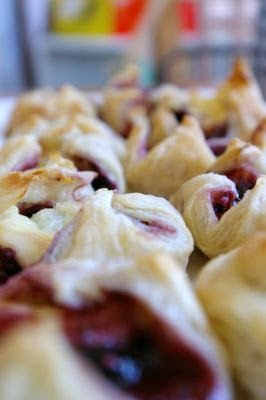
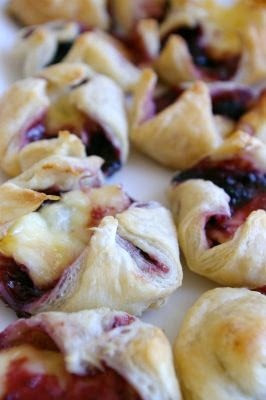
Well, this month’s theme is finger food. I had originally planned to make brie and onion tartlets, but a last-minute morning walk meant I had less time than I thought I would. In a pinch, I grabbed frozen Trader Joe’s puff pastry out of my freezer (it’s sold flat, so it takes a mere 10 minutes to thaw) and made these brie-raspberry bites. They’re the perfect appetizer to make in a pinch, and they’re sweet without being dessert-y.


Black Raspberry-Brie Bites
2 sheets puff pastry, thawed and rolled to 1/8-inch thick
1/2 cup raspberry or black raspberry preserves
32 frozen raspberries or black raspberries, thawed and drained
Wedge brie cheese, cut into 32 bite-size squares
sugar

Preheat oven to 400 degrees.

Working with one pastry sheet at a time, slice into 16 squares. I start by slicing into four equal quarters, then slice each of those into four quarters to make each square the same size.

In the center of each square, place 1 piece of brie, 1 raspberry and a dallop of jam.

to make turnovers:

Wet your fingers, and run them along two connecting edges of one of the squares.

Fold the far corner onto the near corner, and using two fingers, press the edges together to form a triangle. You may have to really press to make the dough stick to itself, and wetting the dough should help.

to make bundles:

Wet your fingers, and run them along all four edges of a square.

Bring the four corners together, pinch at the center, and pinch along the edges to seal.

When all turnovers/bundles are created, place them 1/2-inch apart on baking sheets. Bake for 15-18 minutes, or until golden. let cool 5 minutes, then serve warm.

{ 6 comments }

Strawberry Rhubarb Tart with Almond Streusel

Rhubarb is finally, finally in season … it’s about time.

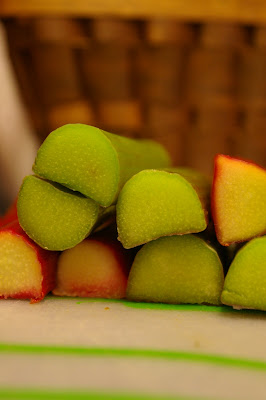
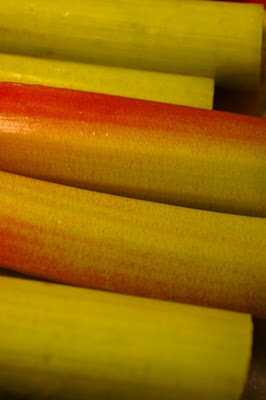
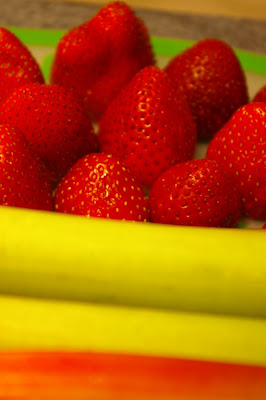
It has the perfect sweet-tart flavor that complements the summer’s last strawberries and pairs perfectly with many fall foods. If you can’t spot rhubarb in a crowd, think “sweet, red celery.” That’s what rhubarb looks like. It’s incredibly versatile; I use it most frequently to make sauce, jam, cake, crumble, and pie.

When I got my CSA box this past week, I was pleasantly surprised to find rhubarb among the contents. I later realized that this was because I had ordered rhubarb, then forgotten about it…but still, what a pleasant surprise! I’m entertaining this weekend, and rhubarb is a great place to start.

I promise to post more rhubarb recipes as more of it pops up in my CSA box. For now, this tart is a riff on my usual strawberry rhubarb pie recipe. Unlike pie crust, tart crust is sweet and less crumbly. While my pies usually have a lattice or crumble top, this tart is open-faced, garnished with a simple almond streusel. I do enjoy a good lattice crust, but this tart is an opportunity to show off your fruit-arranging skills. What? Yes, your fruit-arranging skills.

Strawberry Rhubarb Tart with Almond Streusel
serves 8.
Tart Crust: taken from Tartelette
  • 1 1/2 cups flour
  • 1/2 cup powdered sugar
  • 1 stick plus 1 Tbsp unsalted butter, chilled and cut into small pieces
  • 1 egg yolk
Blend dry ingredients with a hand or stand mixer. Add butter and blend until mixture resembles coarse meal. Add egg yolk; blend until dough comes together. Wrap in plastic, and refrigerate while preparing ingredients for the tart.
After about half and hour, the tart dough should be just chilled enough that it rolls nicely. Place dough between two sheets of plastic wrap and roll out into a circle slightly larger than the size of your tart pan. (I use a round fluted tart pan, but any shallow baking pan will do.) Peel off the top layer of plastic wrap. Hold the dough from the layer of plastic wrap beneath, and carefully turn onto your pan. Once your dough is on the pan, remove the top layer of plastic and start fitting your dough to your pan, pushing it delicately into the crevaces and corners without changing the thickness of the dough too much. trim the ends, and make a decorative outer lip if you desire.
“Dock” your dough to the pan by spearing it with a fork in several spots, and bake for 10-15 minutes at 350. This will ensure that the crust holding the (liquidy) ingredients will still taste flaky, and not mushy.
Filling:
  • 3 stalks rhubarb, cleaned and cut into 4-inch-long slices
  • 1 piece of the rhubarb thinly sliced (for the tart’s center)
  • about 12 nice strawberries, cleaned
  • 1/2 cup granulated sugar, more for dusting
  • 1 tsp. cinnamon
  • grated zest of one orange
  • powdered sugar for dusting, optional
Mix sugar, zest, and cinnamon in a small bowl. Set aside.
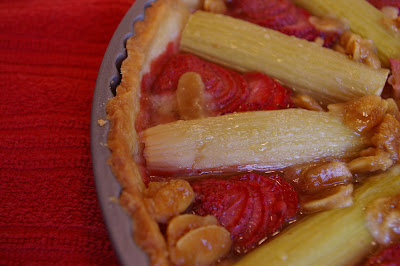
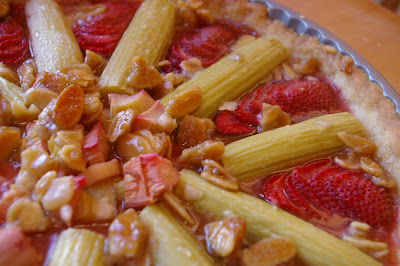
Put your rhubarb into the bottom of the pre-baked tart crust as spokes of a wheel, with their tips touching at the center. You’ll find that the center will have an empty circle, where all the tips of the rhubarb slices meet. I usually fill this with thinly sliced rhubarb and sugar, as in the pic below.

Slice strawberries one at a time, and arrange, fanned out, between the rhubarb slices. Sprinkle the whole thing with the sugar mixture.

Streusel:
  • 1 cup sliced almonds (I prefer toasted but raw is fine too)
  • 1/2 cup light brown sugar
  • pinch salt
  • half a stick of butter
  • 1-2 Tbsp. flour

Bring butter to a simmer in a small sauce pan until it melts and starts to turn golden. Add sugar and let it dissolve completely. When mixture has no remaining sugar granules, add almonds, make sure heat is on low-med, and stir. When almonds are fully coated, add 1 tbsp. of the flour and stir. the mixture should turn cloudy, and thicken. if mixture isn’t thick and goopy, add the second Tbsp. Stir. When mixture starts to clump, remove from the heat and allow to cool. When it’s cool, break it up with your fingers and sprinkle it on top of the tart.

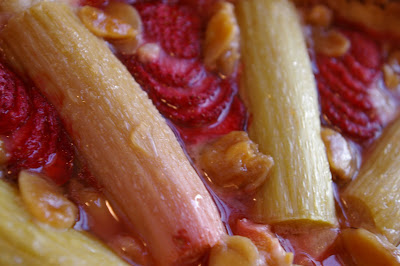
Bake the tart at 350 degrees for 30 minutes, or until rhubarb is soft and has released some of its natural juices.

{ 3 comments }

my office desk stash

york peppermint patties
mini applesauce cups
almonds
those ginger cat cookies from Trader Joe’s
honey wheat pretzels

what’s yours?

{ 1 comment }

Ok, lots of words in the title, I know, but it’s not really all that complicated to make.

I was in a creative mood last night, and I’d just read a post from Elise at Simply Recipes describing a recipe for Chile Verde. Pig is pretty high on the treif list, but I love tomatillos, and hot peppers are my new favorite food, so I figured I’d take a stab at making the dish sans pork — which basically amounts to a yummy and versatile green sauce. I made several adjustments which I’ve spelled out in the recipe (below).

Now, tilapia en papillote.

“En papillote” is French for “in paper.” This cooking technique involves creating a steam packet out of parchment paper, which seals flavors and juices into whatever steams inside. I ususally layer a protein (fish, meat, tofu, even) with fruit and/or vegetables, spices, salt and pepper, and just a few dashes of sauce or scented oil, depending on the recipe. Last week, my mother served salmon en papillote with peaches, julienned carrots and red peppers, and a dash of sesame oil — simple and absolutely delightful.

The technique is a very healthy way to cook: it requires no oil, and ingredients are cooked just to doneness, so that they retain most of their nutrients. It’s also relatively easy and quick: Just place the fish on the parchment paper, top with the other elements (or place them beneath the fish), fold up, and bake in the oven. Finally, en papillote makes for a beautiful presentation, as the fish and all its accoutrements are unwrapped and plated tableside. I know, it sounds like a lot of fussing, but it’s really not that bad. Think of it as a ziploc sip n’ steam bag but it’s cheaper because it’s just a piece of paper. Plus, it won’t leak dioxins into your dinner the way plastic does. One rule of thumb about en papillote cooking: everything you cook inside the paper must have more or less the same cooking time. This means that if you’re including carrots, potatoes, or other starchy things that take a while to soften, you must slice them very thinly so that they will cook more quickly. When you make this (yes, you will make this), let me know how it goes.
Chile Verde Sauce
2 Anaheim (or other) chiles — Elise uses jalapeños
3 tomatillos, husks removed and cleaned well
1 small yellow onion, diced
3 cloves of garlic
salt
olive oil

Put tomatillos and garlic cloves under a broiler for about 12 minutes, until the tomatillos’ skins are a browned and the flesh is soft. Remove, and allow to cool. Meanwhile, sauté the onions in the olive oil over low heat, until soft, translucent and caramelized.

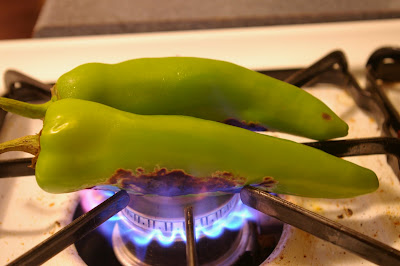
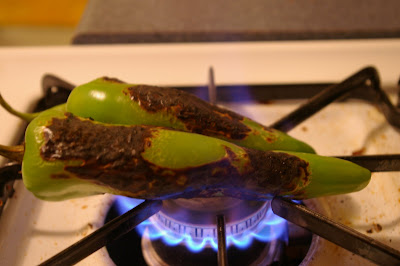
Roast peppers naked on a gas stove (as seen above — yowza!) until their entire skin is charred. Put in a peper bag and allow to steam for a couple minutes; then remove, run under water, and slide the skin right off, exposing the flesh of the pepper. chop coarsely.

Put the tomatillos in a blender and pulse. Add, then chiles, and season liberally with salt. Transfer to a bowl and store, covered, in the fridge for up to a week.

Tilapia en papillote with purple potatoes
serves 2.
2 filets of tilapia
2 pieces parchment paper, about three times the size of the filets
2 purple potatoes
1 lemon
salt and pepper
buckwheat honey

Lay tilapia filets in the center of the pieces of parchment paper.
Slice the potatoes VERY thinly (otherwise they will take longer to cook than the fish)
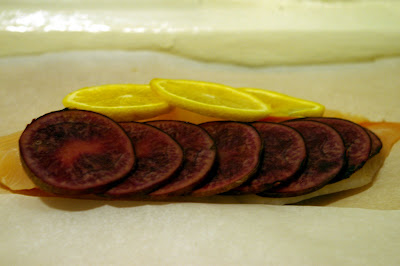
Slice the lemons. Stack the lemons and the potatoes in a domino-effect on top of the filet (I did them separately, but one may alternate them also for a more exciting presentation.) Alternatively, place the potatoes beneath the fish and the lemons on top.
Season with salt and pepper, and drizzle 1/2 a teaspoon (max!) of buckwheat honey atop each filet.
Wrap the filets as follows:(Like my elementary school drawings?)
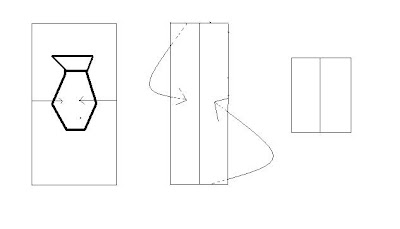
Step 1: place fish in the center of paper with potatoes, lemons, salt, pepper and honey.
Step 2: fold the LONG sides of the paper over the fish toward the center so that they overlap.
Step 3: making sure that the paper stays overlapped, fold the short ends BENEATH the fish toward the center. In the finished packet, the fish should be resting on the two short sides of the paper (folded so that they’re each in a double layer), keeping the packet closed.

Ok, that was the hard part. Now put the packets on a baking sheet, and insert into a 350-degree oven for about 15 minutes. You may have to leave them in for 20, depending on the thickness of the filets. I always open my own to check it so that I don’t serve anyone accidentally undercooked fish.

That’s basically it: for this dish, I drizzled a bit of honey over the chile verde, then plated the fish atop the sauce, and garnished with a sliced pear to complement the acidity of the chile verde. I’d probably skip the honey on the chile next time, as it tends to overpower the flavor of the chile.

*Phew!* enjoy.
{ 0 comments }

Where is Fall?

As fall-themed recipes have started popping up on other people’s blogs, I’ve begun to notice my own reluctance to dig out the pumpkin puree from the pantry. Normally I make fall recipes too early, out of sheer excitement for sweater season, but this year the transition is taking a while. It’s already mid-October and the weather has not let up one drop. As my friend Dave so eloquently put it, “where is the cold, apple-crisp air of fall? Things seem unnaturally fecund, overgrown, about to rot.”

Perhaps this post will trigger a weather change. If only I had that much influence…

{ 0 comments }

Slow-roasted onions, fennel and tomatoes

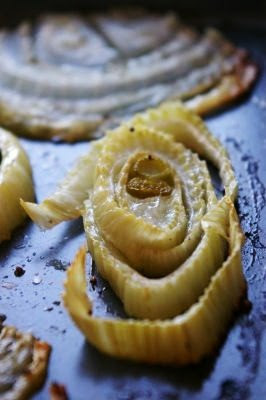
If you’re an onion hater, this dish will convert you. Slow-roasting onions releases their natural sugars slowly without burning them, so that by the end they’re smooth, slippery and taste like caramel.

The tomatoes undergo a similar transformation: they become soft and sweet, and their flavors become incredibly concentrated.

And the fennel…well, you get the drift: soft, sweet and delicious.


The technique is simple (I feel like I’ve said that before…): roast thick slices of the veggies in a medium-hot oven for an hour or so. Instructions below are in slightly more detail, promise.

Slow-roasted onions, fennel and tomatoes
serves 4-6.
3 nice, large, red tomatoes, cut into four slices each
2 white (not yellow) onions, cut into four-five slices each
1 bulb fennel, fronds removed, cut into five-six slices each
good olive oil
salt
pepper

Preheat oven to 300 degrees.
Places the slices randomly on two cooking sheets. feel free to smoosh and squeeze them so that they all fit. It’ll only make things taste better. Plug the spout of your olive oil bottle with your finger and drizzle the oil over the vegetables. use your fingers to spread the oil so that it coats the exposed surface of the vegetables. Season liberally with salt and pepper.

Cook on 300 degrees for about an hour, flipping onions and fennel once at the halfway point. Leave the tomatoes alone as much as possible. You’ll know it’s done when onions are caramel-colored and soft and your kitchen smells ridiculously good.

To serve: layer vegetables on a white tray: onion or fennel on the bottom, then tomato, then fennel or onion.

{ 0 comments }

quick greek stew


If you made the slow-roasted dish and have some leftovers, here’s a great way to take care of ’em:

Quick Greek Stew

slow-roasted onion, fennel and tomato
leftovers
fresh ground pepper
1/4 cup feta cheese
a few kalamata or other greek olives
fresh basil

Roughly chop onion/fennel/tomato leftovers into large pieces. Toss in a shallow sauté pan with some of their juices, about 3 minutes. Add a bit of crumbled feta cheese, a few greek olives, and a crank of the pepper mill. Cook about 2 minutes longer. Garnish with fresh basil.

{ 0 comments }