
When summer rolls around, the heat in Washington DC can be rather prohibitive. Almost nothing is worth touching that oven dial, especially in our loft apartment that gets a whole lot of hot air and nary a breeze. Dinner most frequently comprises an easy salad like this broccoli slaw or this Mediterranean orzo salad, or maybe even a cold soup like this quick-and-easy zucchini number I made last summer. Tie that all together with some crusty bread and I’ve got an easy supper.
Salads and cold soups are definitely an antidote to the heat and humidity, but when the weather is so debilitating that I want to just crash when I get home, a cheeseplate is really the way to go. Cheeseplates are easy to assemble but elegant enough for company, and while people seem to think they go best with red wine, I’ve found (and had more authoritative sources corroborate) that a chilled (but not too chilled) glass of white wine makes even better company.
Recently, I was reading a great post from Mr. Amateur Gourmet, Adam Roberts, about his trip to the famed Murray’s Cheese in Greenwich Village and his quest for the perfect cheese plate. He asked the man behind the counter for help selecting his cheeses, and the man gave him a mild but interesting goat cheese, a sharper cow-and-sheep cheese, and a stinky washed rind cheese. Lost yet? Don’t despair. You can do as Adam did — and as I often do — and ask the advice of the person behind the counter. My favorite cheese spots here in DC are the wonderful Cowgirl Creamery, where cheese nerds come to play, and Calvert Woodley, which has a great selection and some really helpful folks behind the counter. That said, even the folks at Whole Foods can help steer you in the right direction. Meanwhile, whether you’re enlisting a team of advisers or going at this alone, there are a few basic things that are helpful to know before embarking on your cheeseplate expedition. This post will shed some light on how to build a cheese plate, how to cut and serve each of the cheeses, and what sorts of breads and spreads make the best vehicles and complements for enjoying the cheese.
[click to continue…]
{ }
Just thought you’d all like to know that we’ve been tinkering around here at NDP and I’ve managed to make some biscotti that are better for you and equally delicious. After some tinkering, I made the same ones I made the last time — cherry almond — with half white whole wheat flour and half turbinado (unrefined) sugar. I’m willing to bet you can even do all unrefined sugar with great results. For the eggs, I used 1 egg and 2 egg whites this time, and it produced a crunchy cookie that wasn’t too much of a tooth-cracker. Just a little FYI for the weekend. I’ll be back with an actual post soon…
{ }
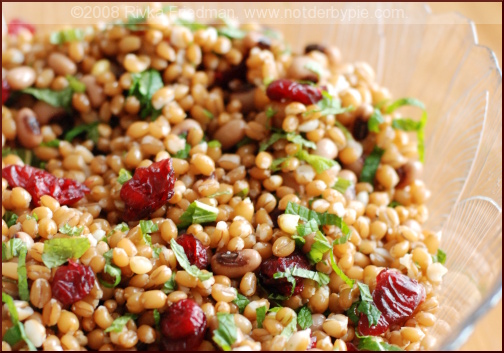
Yet another installment of my weekday lunch series; you can never have enough recipes for midday workplace eats.
I don’t have anything to share about this recipe that’s particularly exciting. It’s just another rendition of my standard grain+bean+berry+herb salad formula. But I realized as I made this salad that it was my first time making wheatberries. At least, I’m pretty sure it was my first time — in any event, it definitely won’t be my last. Wheatberries are pretty underrated, so much so that when I served them last Friday night, most everyone around the table asked what they were. “Wheat,” I replied. No one got it; “What part of the wheat? Like, they’re really just wheat? Are they some sort of berries that grow off the wheat crop?” No, I replied, it’s really just wheat. Funny that we don’t know what the food we eat most often actually looks like, but that’s a story for another time.
Wheatberries are sweet and nutty, with a nice solid texture. They’re probably super versatile; I can envision them in a variety of salads, soups, and stews. Writing that line, I just remembered that I’ve actually used wheatberries before, when making the Sephardic version of cholent, the rib-sticking stew made on Friday and cooked at a low temperature through the night. Unlike the Eastern European recipe of barley, beans, potatoes, beef, and eggs, the Sephardic version, called “Hamin,” is made with wheatberries, chickpeas, and dates in addition to the beef, chicken, and other leftovers. The wheatberries are cooked inside cheesecloth wrapper within the dish, so they can be piled separately onto the plate as a bed for the rest of the goodies.
[click to continue…]
{ }

I absolutely love sour things. I’ve been known to suck on a lemon slice once in a while, just for kicks (though my dentist scolded me for doing it, so I reluctantly put the habit to rest). When it comes to pickles, I’m a full-sour kinda gal. None of that dill or bread-n-butter stuff; I like’em super super sour. I’m into cucumber pickles, but I can’t say that they’re my favorite — not by a long shot. No, my absolute favorite pickle is a pickled green tomato, especially if it’s from Guss’ Pickles on the Lower East Side. My first time at Guss’ was on an 8th grade class trip, when we stopped there very briefly on our way back from grabbing knishes, bialys, deli, and other LES specialties. I remember watching friends get themselves just one pickle, or two. When I looked deep into the plastic tub in front of me and saw green tomato quarters, bobbing up and down in the brine, I knew that’s what I had to have. Sadly, Guss didn’t sell the tomatoes by the single back then — only by the pound. Obviously, I bought myself a pound of pickled green tomatoes. Reluctant to waste, I ate them all. Boy were they good.

Not to dismiss cukes, but compared to the tomatoes and other exotic pickled things, they’re kind of ordinary. I can promise you that this cauliflower recipe is anything but. I originally published this recipe in an article I did for My Jewish Learning on Israeli Independence Day, but these sour, cardamom-spiked florets are great year-round.
[click to continue…]
{ }
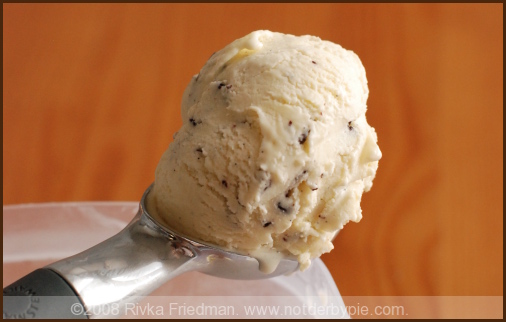
Recently, I discovered something of an oddity in my ice cream-eating habits. When I buy ice cream, I’m pretty particular about how I like it: Ben and Jerry’s coffee heath bar toffee crunch. It’s really that easy. I’ve never been one to order vanilla, chocolate, or any other flavor that’s that simple. When I order chocolate, it almost always has some swirl, ribbon, or maybe even some of those little chocolate-filled bits. Cheesy, I know, but I like my ice cream with lots of stuff in it, what can I say?
That affinity for add-ins rapidly fades when I’m making ice cream. When I’m making the stuff from scratch, I’m a total purist. Vanilla is my most frequent concoction, and in my mind, it’s pretty hard to beat. If hard pressed, I think I’d probably pick my homemade vanilla over a pint of B&J’s Coffee Heath. Though not without some serious deliberation.
Why is that, you’d like to know? I think it has something to do with the sheer quantity of egg yolks and cream and not-so-cheap vanilla beans that go into a good quart of frozen. (That’s six egg yolks, 1 cup of whole milk, and 2 cups of heavy cream, thank you very much.) It’s also got everything to do with fear of failure — or, better put, fear that the cherry pit ice cream you were so curious to try is actually a total flop. When you’re working with farmers’ market eggs and organic cream, you’re spending a pretty penny; I guess I want to make sure I get my money’s worth. Call me a pincher, but you know what? Vanilla comes out just perfect, every single time. It also tastes so pure, so much like the ingredients that are used to make it, that I find it difficult to veer far from it.
[click to continue…]
{ }
I dunno about you, but I’m feeling more and more compelled to get a composter. It seems ridiculous that I throw away several pounds of biodegradable stems, peelings, cores, pits, seeds, skins, and rinds, when I could compost them instead. I know that composting in urban environments can be challenging: living as we do in the heart of DC, our access to yard space is limited nonexistent, and we aren’t exactly teeming with the space (or money, for that matter) to install one of those large, expensive all-in-one electric composters. That said, the amount of waste that my one household — a household of two — can produce in one week is kind of mindblowing. So I’m considering getting a compost tub, just a little guy for the house. One of the biggest lobbyists for this purchase is our friend Matt, who lives with his wife Bryce around the corner from us, and has kindly volunteered to take our compost if we’ll drop it off (right, Matt?). I figure, I’ve got someone to take the stuff, and I’ve definitely got room for a little bin in my kitchen: now is as good a time as any to stop wasting and start composting. Huzzah!
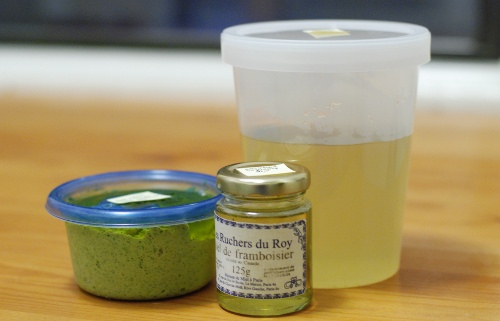
Composter in hand, I’ll stop throwing away the bits of produce that I tend not to use in cooking. But there’s another way to think about limiting waste, one that’s near and dear to me as a food blogger, and that’s making sure to extract as much flavor as possible from the ingredients we buy. Not only is this best practice for maximizing use of the food we buy, it’s also a way to ensure that we make the most of our purchases, which in turn can save all of us a little hard-earned dough.
Within the past two days, I’ve made broth out of the stems of asparagus, cooked a mint-infused simple syrup with the stems and some leaves of a massive mint harvest that the Masseys gave me as a gift, and made an herb pesto with leftover walnuts, going-going-cilantro, and — you guessed right — more of those mint leaves. What’ll I do with each of these things? I’m not 100% sure, but if you hear that I served herb-encrusted salmon and mint spritzers for Friday night dinner, don’t be surprised.
[click to continue…]
{ }

Yet another installment of my weekday lunch series. You can never have enough work-lunch-friendly dishes, now can you?
I work on the ninth floor of my firm’s office building. There are lots of conference rooms on our floor, and when a lunch meeting yields leftovers, they usually make their way into the ninth floor kitchen, which happens to be right across from my cubicle. When we hear the clomp-clomp of high heels in the kitchen and the rustling of plastic trays and wrap paper, we know it’s going to be good. Within seconds, my entire pod will have descended on the kitchen, scavenging for the best wrap, the freshest-looking corner of the spinach salad, the last piece of baklava. After poking around for ourselves, we’ll shoot out an email to our friends down the hall alerting them to the free food bonanza. We’re that nice.
[click to continue…]
{ }

If you’re a regular reader of this blog, you know by now that I’m a self proclaimed ingredient-adder. I’ve got issues leaving things simple: I find myself constantly tempted to tinker, to add just one more spice or sauce or vegetable or seed or something. I’ve been working on it, folks, really I have, but it ain’t easy.
As much as I’m inclined to clean out my pantry into a recipe, there are certain recipes that are not to be futzed with. One of those recipes is Marcella Hazan’s pasta with broccoli rabe. Hazan is a legendary Italian cook and cookbook author. Her directions are so very precise, her knowledge and expertise so colossal, I’d be crazy to fiddle with her ingredients or proportions.
[click to continue…]
{ }