≡ Menu

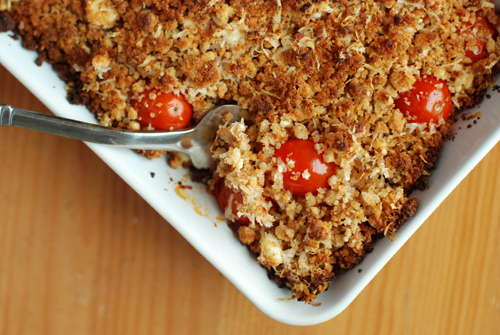
Bursting Hot Tomatoes with Cheesy Breadcrumbs

There’s a little game I play as fall wanes into winter. It’s about tomatoes. In summer, when tomatoes are at their peak, I want nothing but to eat them — lots of them, all the time — in preparations as simple as can be. Don’t make me pasta with tomato sauce when bursting, juicy, raw tomatoes can be had in abundance; slice up a couple, drizzle a little olive oil on top, share a pinch of salt, and I’ll be on my way, thank you.

The fall tomatoes in these parts aren’t half-bad, either. Some farmers — Toigo, notably — do a great job with the late-season fruit. But December and January (and beyond) are murky tomato territory, where the red ones are all found beneath the fluorescent lighting of your nearest grocery store, and the farmers market tomatoes tend to be green, for frying or pickling only.

Now before you let anyone tell you that supermarket tomatoes are good for nothing, I’ve got to chime in. I’ll agree wholeheartedly that January beefsteak tomatoes are about as mealy and flavorless as they come. However, the grocery store’s cherry tomatoes are passable when you really, really need them. Furthermore, there are ways to enhance supermarket tomatoes to the point that they’re not just edible, they’re actually kinda tasty. This is one of those ways.

[click to continue…]

{ 2 comments }

Down and Dirty Pasta e Cecci

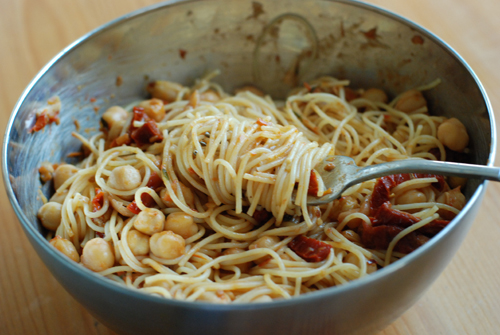
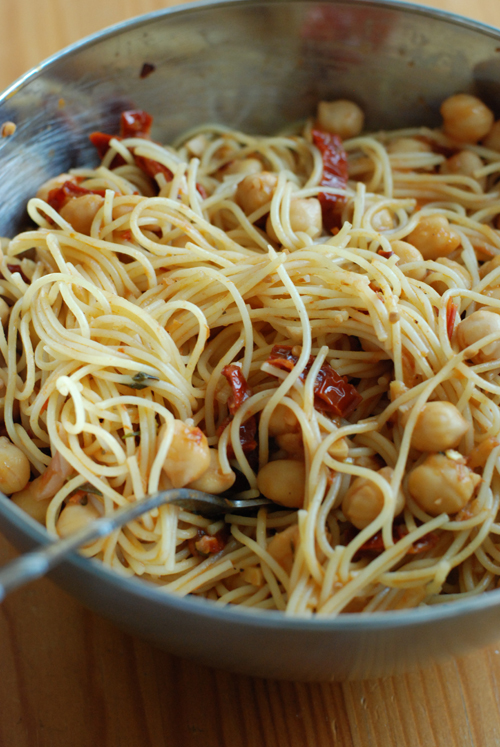
Anything that has the words “down and dirty” in the title is something I will, sooner or later, make. “Down and dirty” suggests a rough-and-tumble version of the refined original, something you’re more likely to eat on your front stoop than in a dining room. When I hear down and dirty, I see myself in cutoff jean shorts and one of those ribbed white tank tops, sitting outside on a balmy summer day. There are mosquitos in the air, bangs in my face. I’m eating from a clay bowl I threw in the pottery studio down the street. When lunchtime rolls around, I notice some chickpeas in the cabinet, so I decide to throw them in with some chili, anchovies, and pasta, and call it lunch. Down and dirty lunch, that is.

Surely you can understand how, when I saw a recipe for “down and dirty pasta e cecci” on Food52’s website (via Jennifer Steinhauser of NYT, via her friend fisheri — that’s his username, not his real name — oh, the confusion!), I simply had to make it. Mind you, I didn’t even know what “cecci” were. I don’t speak Italian. But down and dirty pasta is something that best be coming out of my kitchen, like, pronto.

[click to continue…]

{ 4 comments }

Moroccan Salmon with Curried Yogurt

Though it doesn’t appear very often on this site, fish — salmon in particular — is a staple in the NDP kitchen. I like it because it’s a substantial cornerstone of a meal without being as heavy as meat often is. I frequently host lunch on Saturdays, and I almost always cook for these lunches in advance; salmon can be served cold with a dipping sauce, obviating the need to carefully par-bake it before reheating the next day to serve. Also, it’s delicious.

Last year, I frequently cooked fish “en papillote,” each filet wrapped with care in its own little parcel of parchment paper. It’s a very healthful way of cooking fish, in its own juices and little else. Sometimes I’d add slivers of thai bird chillies or slices of peach, but the method was always the same. This year, I’m planning to broil my fish more often. That little spot at the bottom of my oven doesn’t get enough airtime, and considering its ability to make sugar into caramel and turn anything that beautiful shade of brown, it really should.

[click to continue…]

{ 0 comments }

Not everyday is as productive as last Friday. In about 2 hours, I made a fantastic salad, discovered a new cooking technique, and finally learned how to achieve that elusive sweet-salty-tangy-spicy balance in a Thai vinaigrette. It’s all thanks to Lynn Rossetto Kasper. As if I’m surprised.

I am a huge fan of Lynn Rossetto Kasper. I’m a loyal listener to her “The Splendid Table” podcast, and I absolutely loved her pithy and clever “How to Eat Supper” podcasts, which she co-hosted with TST producer Sally Swift (until recently, when they suddenly stopped coming out…) So I’m sort of embarrassed to admit that it took me until last week to sign up for Lynn’s “Weeknight Kitchen” newsletter. Now maybe it’s too soon to pass judgement, seeing as I’ve only gotten two issues. But this is Lynn Rossetto Kasper. Every recipe is a run-to-your-kitchen recipe. As expected, just one day after the email landed in my inbox, I was at the counter, surrounded by heaps of green cabbage.

The recipe in last week’s edition was for a Thai cabbage salad with tofu, cashews, and pineapple. D was quick to point out that I cut my pineapple slices so large as to intimidate my guests (sorry, ya’ll! Hope the yellow didn’t scare you away) so in the future, I’ll make my pineapple more….welcoming. But aside from that, I found this salad delightful. It’s got really well-layered flavor: the bitter freshness of cabbage, the tangy sweetness of pineapple, a generous handful of cashews, scallions and herbs, and a biting vinaigrette rounded out with fish sauce (one of Lynn’s favorite ingredients: it’s got tons of umami, or glutamate, which helps give that extra something to…well, almost anything.)

[click to continue…]

{ 3 comments }

Syllabub

To Amanda Hesser’s list of foods whose names alone command that you make them, I add this quirky dessert. Syllabub! Every time in the past two weeks I’ve called it by name, it’s been met with total crack-up laughter. Don’t you want to make it too, just to be able to say you whipped something up and it’s called Syllabub? Ha.

Now that I’ve made it, I can tell you the name shouldn’t be your only motivation for giving Syllabub a whirl. I came across the recipe in an old issue of Saveur (1996, maybe?) that I was reading last weekend at a friend’s lake house in Wisconsin. The picture caught my eye: a big, heavy-bottomed glass was filled to the brim with what looked like vanilla custard, topped with a bit of lemon zest and a sprig of rosemary. Intrigued, I read the piece: turns out, syllabub is basically whipping cream combined with sherry and some flavorings. Something about the alcohol or the acid of the lemon juice (or maybe both) thicken the cream without much whipping — it’s very bizarre! — so very little, if any, work is necessary.

[click to continue…]

{ 4 comments }

Graham Crackers

D’s stepmom, Terri, has an absolute weakness for graham crackers. She says they’re the one thing she absolutely can’t keep in the house, because once she opens the package, she’ll eat every last one. I learned this on our recent trip to Israel, and was pleased to be able to reply that in my bag, I just so happened to have two homemade graham crackers that I’d packed as a plane snack. Naturally, her eyes bulged. I bounded up the stairs and grabbed them immediately.

It had all started innocently enough: having given in several times the previous week to sugary, buttery shortbread and chocolate chip cookies and really so much more, I was determined to bake a snack that would satisfy my sweet tooth without pushing me over the edge. That whole “new year, new habits” thing has nothing to do with it, promise.

Graham crackers were the perfect choice. (They’re called crackers — how bad could they be?) I made a batch a couple days before we left; I gave a few away as holiday presents, and the rest I played around with. Some got a one-sided dunking in chocolate, others became sandwiches.
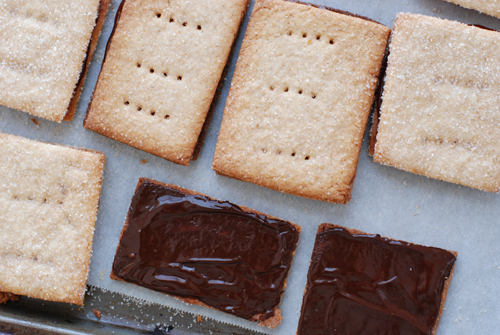
The cookies were just perfect. They were addictively crunchy, and the addition of whole wheat flour gave them a rustic, graham-y quality. And don’t forget the generous dusting of cinnamon sugar to finish them off.

Now Terri wasn’t all that enthused by the graham crackers, because the particular pair I’d brought were sandwiching a thick layer of intensely brown caramel, which overpowered the rather subtle flavor of the graham crackers. I liked ’em just fine, but I probably won’t make them again. Graham crackers are meant to be simple, the kind of thing you munch alongside a steaming cup of tea. They satisfy a sweet craving just perfectly, no caramel or chocolate needed.

Graham Crackers
adapted ever so slightly from The Washington Post

For the graham crackers

9 tablespoons plus 1 teaspoon unsalted butter, at room temperature
3/4 cup plus 1 tablespoon sugar
3/4 cup plus 1 tablespoon flour, plus more for rolling
1 1/3 cups whole-wheat flour
4 teaspoons baking powder
3/4 teaspoon salt
6 tablespoons whole or low-fat buttermilk or milk

For the topping (optional)

1 cup sugar
1 tablespoon ground cinnamon

Combine the butter and sugar in the bowl of a stand mixer or hand-held electric mixer. Beat on medium speed until light.

Combine the flours, baking powder and salt on a sheet of parchment paper or wax paper.

Reduce the speed to low; add the flour mixture, then the buttermilk, in several increments, ending with the flour; beat to form a soft dough. Divide the mixture in half, then wrap each portion in plastic wrap. Refrigerate for 1 hour or until well chilled.

For the topping (if using): Combine the sugar and cinnamon in a bowl.

Position oven racks in the upper and lower thirds of the oven; preheat to 325 degrees. Line 2 rimmed baking sheets with parchment paper.

Lightly flour a work surface. Working with 1/2 portion at a time (keeping the others chilled), lightly flour the top of the dough. Roll out to a rectangle with a thickness of slightly less than 1/4 inch. Use cookie cutters to cut into shapes, or use a sharp knife and a ruler to cut the dough into 2-by-3-inch rectangles. Alternatively, use a scalloped cutter to give your cookies a wavy edge. (I did this on batch number 2.) Prick each cookie two or three times with a fork, and place the unbaked crackers on the baking sheets, spaced 1/4 inch apart. Sprinkle evenly with the topping, if using.

Bake for 6 to 8 minutes, then rotate the baking sheets top to bottom and front to back. Bake for 6 to 9 minutes, until golden brown and baked through. Let cool on the baking sheets before serving or storing.

{ 4 comments }

Crispy Kale Chips

Hello there readers, and hello 2010! I’m back from Israel and hope you enjoyed the dispatches from abroad. In truth, there’s so much more to tell: a dear friend took D and me on a fabulous tour of the Old City’s Christian Quarter, where we ate amazingly fresh hummus, climbed down to secret underground cisterns, and visited a tucked-away Austrian hospice for excellent cappucinos and Jerusalem’s best apple streudel. And that was just one morning!

But now we’re back to the grind, and besides, you must be tired of my rants about my travels. You come here for recipes, and I aim to please. So let’s talk about kale chips, shall we?

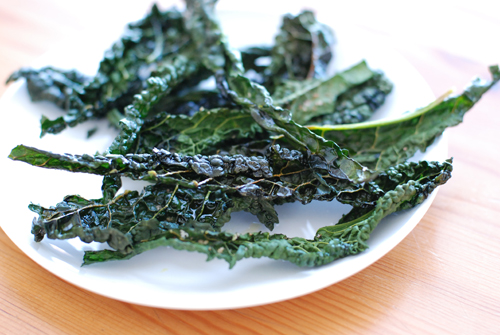
I think I first read about crispy kale in the late Gourmet Mag. The recipe was as simple as they come — kale, olive oil, salt, pepper — and accompanying it were stunning photos of long, evergreen-colored leaves shooting out of a tall glass. Gourmet said the kale was the perfect cocktail party food, and looking at the pictures, I had to agree. I could envision these beautiful vases of kale chips placed on a long table, giving height to the usual array of flat cookie platters and cheese plates. Yum.

One evening, I had a bunch of kale to use up and decided to give the recipe a go. If it was a success, I figured, I’d make it at my next dinner party; the beautiful chips were certain to impress.

But then I ate one.

Can we discuss the fact that my entire mouth, like every single tooth, had green flecks all about? And flecks is an understatement. I might as well have colored my smile with green marker, it was that bad. Cocktail party food my #$@*^%!!! Kale chips are absolutely delicious — they’re crispy, and salty, and perfectly peppery, utterly addictive in short — but they’re something to be eaten at home alone, or with someone who really, really likes you. Either way, be prepared to laugh.

Don’t let me green teeth scare you away completely, though: these kale chips truly are delicious. If any of you have made New Year’s resolutions to eat more vegetables, consider this recipe a belated holiday gift. You can easily polish off an entire batch of kale this way.

Kale Chips
adapted from Gourmet

These chips are delicious just so, but they really pop with a last-minute squeeze of lemon, if you have it handy.

1 bunch kale, cleaned and dried, center stems removed
olive oil
salt
pepper
wedge of lemon, optional

Put the kale in a large plastic bag, drizzle about 1/8 cup olive oil inside, and shake and massage to combine. Add more oil to the bag as needed until all leaves are coated in the oil. Spread kale leaves in a single layer on as many baking sheets as you need, and sprinkle generously with salt and pepper. Bake at 300 for 20-25 minutes, until kale is crispy all over. Cooking time depends on age and dryness of kale, so watch carefully and remove when every piece is crispy. Serve immediately, and squeeze lemon overtop just before serving, if desired.

{ 4 comments }

Morduch

Judging by its exterior, Morduch has developed its reputation entirely by word of mouth. The sign outside is small and dirty, and the restaurant is not much more than a hole in the wall, overshadowed in size and grandeur by its neighbor, the shuk (open air market). It’s not the kind of place you notice just walking by; for Morduch to be full as consistently as it is, people must be talking about it. And I can assure you, they are. I actually sat down on the bus the day after I started writing this post, and sure enough, the two women next to me were discussing Morduch.

Morduch serves classic Israeli comfort food: warm hummus with whole chickpeas and ground beef, and kabobs with rice and tomatoes, are both menu staples. But they’re known for their soup — kubbeh soup, in particular.

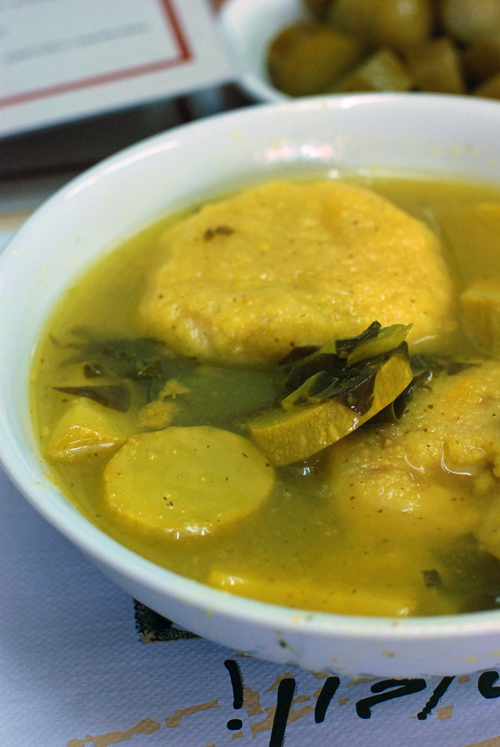
There are three varieties of kubbeh soup at Morduch. The first is called “marak kubbeh adom,” or red kubbeh soup. It’s a mildly-spiced tomato broth with celery, a couple other vegetables, and big kubbeh, or meat-filled semolina dumplings that have been boiled in the soup. Marak kubbeh adom is generally regarded as the most basic soup; it’s what your friend orders when it’s his first time at the restaurant and he’s still skeptical about the whole kubbeh thing.

The second variety is called marak kubbeh hamusta, and it had me at hello. I first ate kubbeh hamusta in 2004, and was immediately addicted to its mouth-twisting tartness (from sorrel leaves) and rich spicing (from the beef in the kubbeh). There are few things I adore more than hamusta soup.

Given my love of hamusta, I generally don’t look at the menu — I just sit down and order. As I was slurping the last of my bowl last week, I glanced at the menu for blog-reporting purposes and noticed a third soup on the menu: marak kubbeh siskeh. As it’s described by the restaurant, siskeh is hamusta soup for the advanced palate: its spicing is more aggressive, its tartness more pronounced. Basically, an amped up bowl of the already-wonderful hamusta. I had in mind to head back and give it a shot, but there was too much else to do and not enough time, so siskeh will have to wait until my next trip. If you have it, you must let me know how it is!

{ 4 comments }